
Refresh a Miami-Dade block search before relying on it. Parcel ownership, association status, and voter extracts change on separate schedules. Save retrieval dates beside every row, remove duplicates by folio rather than name, and leave protected or absent records unexplained unless another official source resolves the gap.
Verify Miami-Dade Neighbor Findings
Record what each result actually confirms. A parcel card confirms the owner listed for assessment and the mailing address used for tax notices. A deed index confirms parties to a recorded instrument. A voter extract confirms a public registration entry as of its file date. An association filing confirms an organization and its disclosed contact. None of those facts alone proves who slept at an address last night or how nearby people are related.
Use names cautiously in Miami-Dade. Compound Hispanic surnames may be indexed under paternal or maternal components, and accents, hyphens, initials, and Anglicized given names can vary. A trust or company can stand in the ownership field. Compare middle names, dates, co-parties, folios, and legal descriptions before deciding two entries describe one person. Similar names on adjacent parcels are not evidence of a family relationship.
If a web result appears stale, use the custodian's other access channel. The Property Appraiser accepts requests for building jackets with a folio; a jacket may contain drawings, features, or photos but not a survey, and it is not a same-day product. The county public-record portal can route focused requests for existing agency records. Municipal permits and code files must go to the city that governed the address. Keep fees, response dates, and withheld fields in the research notes so missing data is not mistaken for absence.
Document a Miami-Dade Neighbor Buffer
A useful block file records the subject address, map date, chosen distance, target layer, and folios returned. Those details let another researcher reproduce the result instead of trusting a hand-picked list. State when a parcel touches only the edge of the buffer. Roads, canals, gated entrances, and irregular parcel shapes can make a fixed radius differ from the way local residents describe their block.
Keep the original HTML or Excel export from e-Maps, then annotate it with links to parcel cards rather than copying owner names without context. The map's accuracy disclaimer remains part of the evidence. If boundaries appear wrong or recent construction is missing, check the current Property Appraiser card and ask the responsible county or municipal custodian for the existing record. Do not quietly redraw a parcel from an aerial image.
Association and council geography needs the same restraint. A registered organization may cover a condominium, subdivision, or cooperative. A community council represents an unincorporated civic area. Neither boundary proves membership, friendship, relationship, or present residence. Public organization contacts help with meeting notices, governance questions, and civic participation. They should never become a private household profile.
Miami-Dade Neighbor Sources by Block
Each official source describes a different layer. Parcel geography comes first because it sets a reproducible area around the subject address. Ownership, registration, and association records can then be added without confusing one layer for another.
| Source | What it shows about a block | Access |
|---|---|---|
| Miami-Dade e-Maps | Parcel shapes, folios, nearby features and selectable areas | Free web map and HTML/Excel export |
| Property Search | Owner, distinct situs and mailing address, legal description | Free address or folio search |
| Florida voter extract | Public registrations grouped by residence street or ZIP | Request process with protected records omitted |
| Community association registry | HOA, condo and cooperative organizations and filings | Searchable from January 2023 |
| Community councils | Civic representation for unincorporated areas | Ten geographic councils |
| Historical directories | Earlier address-to-occupant evidence | Library and archive holdings |
None is a current directory of all neighbors. Renters, children, nonregistered adults, protected people, and household members may be absent. Keep “owner,” “registered voter,” and “resident” as separate labels.
Map Miami-Dade Neighbors by Parcel
Miami-Dade e-Maps can locate an address, intersection, landmark, folio, township-range-section, municipality, or commission district. Select the Parcels information layer, click the subject parcel, and then inspect adjacent polygons. For a clear block boundary, use Select Area. For a reproducible radius, use Buffer.
- Open Miami-Dade e-Maps and locate the known address or folio.
- Set the information layer to Parcels and select the subject polygon.
- Open Buffer, enter a short distance in feet, choose Parcels as the target layer, and create the buffer.
- Review the selected parcel rows and export them to HTML or Excel.
- Open each relevant folio in Property Search and record the source date.
The map also has street and aerial basemaps, measure tools, layers, Select Area, and print controls. County disclaimers warn that spatial and thematic data may not match current files. The service caps a web query at 1,000 features, which is far beyond a normal immediate-block search but still a real limit.
Insider method. A parcel buffer is more consistent than guessing which house numbers count as nearby.
Check Miami-Dade Owners Carefully
Move each folio into the Property Appraiser search. The parcel card separates the property or situs address from the owner's mailing address and supplies legal description, sale information, assessments, exemptions, building facts, aerials, and a sketch when available.
Matching situs and mailing addresses are consistent with owner occupancy. Homestead is also stronger evidence that an owner declared the parcel a permanent Florida residence. Neither fact identifies every occupant. A trust or company may hold title. A renter may never appear on the tax roll. A different mailing address may locate an owner elsewhere, but it does not prove that person's current home.
For an entire named road rather than the immediate block, switch to the Miami-Dade County street directory. That workflow adds deed chains, permits, and reverse directories at street scale.
Group Miami-Dade Voters Nearby
Florida voter extracts may be grouped by residence street, house number, and ZIP. Public fields can include name, residence and mailing address, date of birth, party, supplied phone or email, status, precinct and district data, and voting participation. Participation never reveals a ballot choice.
The monthly file reflects active and inactive voters as of the prior month's end. Confidential and exempt people, preregistered voters, and Address Confidentiality Program participants are excluded. The roll also misses minors, noncitizens, and unregistered adults. Social Security numbers, driver-license or state-ID numbers, registration source, and copied signatures are confidential.
Request county data through Miami-Dade Elections. Extensive requests receive a quote and require full prepayment. A nearby registered voter is one dated record, not proof of the complete current household.
Find Miami-Dade Community Associations
The county's Community Association Registry searches association name, address, folio, municipality, type, and status. Its web coverage begins in January 2023. Results and filed documents can identify governance for homeowners associations, condominiums, cooperatives, and related communities. They do not disclose every member or occupant.
Open the Miami-Dade Community Association Registry represented below.
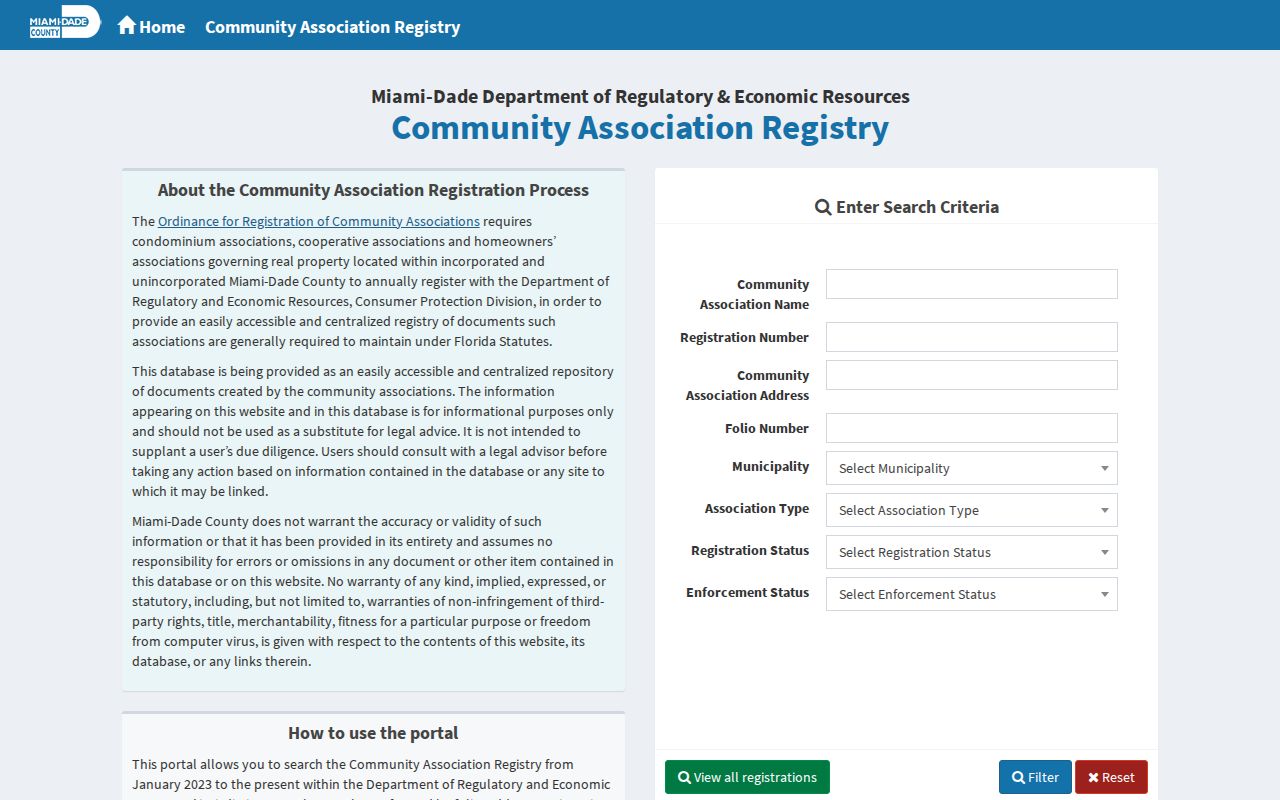
Use its public contact and filing data to identify the organization responsible for a community, then follow that body's own lawful public-contact rules.
Association Registry
Searches HOA, condo and cooperative records by name, address, folio, municipality, type and status.
Community Councils
Ten geographic councils represent unincorporated areas. Council geography frames civic issues but does not name residents.
Miami-Dade Postal Names Can Mislead
A postal address ending in Miami may fall inside another municipality or in unincorporated Miami-Dade County. Countywide assessment, deeds, elections, and court functions can still apply, while local permits, police, and code records may remain with one of 34 cities. The same block search can therefore require both county and municipal sources.
Confirm the municipality in the county address tools before contacting an office. Community-council geography matters only in unincorporated areas, while municipal neighborhood boards may follow other boundaries. ZIP codes and familiar neighborhood names are useful orientation, not proof of government custody.
Official Rolls Versus Neighbor Tools
Official sources disclose their keeper, purpose, date, and legal limits. Commercial neighbor tools combine data from unclear dates and can merge people with similar names. They may charge for a result that is less precise than a free parcel or registration record.
| Point | Official county or state source | Commercial category |
|---|---|---|
| Provenance | Named custodian and defined record | Often blended from many sources |
| Meaning | Owner, voter, filing party, or association contact | May flatten distinct roles into one profile |
| Correction | Custodian process and statutory rules | Provider-specific procedures |
| Block accuracy | Parcel geometry can be reproduced | Radius and address age may be unclear |
Use the official role exactly as stated. An owner is not automatically an occupant, and an association contact is not a membership list. This restraint makes a Miami-Dade neighbors lookup more useful and less intrusive.
Protect Privacy in Neighbor Research
Florida's Address Confidentiality Program provides substitute-address protection for qualifying victims. Other laws shield specified professionals and identifiers. DMV personal information is not a public block roster, and ordinary utility or delivery customer records are not lawful sources for naming neighbors.
Do not infer relationships from a shared surname, proximity, or mailing address. Do not publish a protected address or attempt to bypass a suppression. Public records can help understand parcels, civic groups, and documented ownership, but they should not be assembled to watch or intimidate a person.
Lawful use. Use Miami-Dade neighbor records for civic curiosity, reconnection, or personal awareness, never stalking, harassment, or harm.
The careful endpoint is a source-labeled block picture: parcel owners where public, dated voter entries where lawful, and public organization contacts. It is not a claim that every person shown still lives there.