
Miami-Dade City Directory Holdings
The historical shelf is not one unbroken run. Research confirms several editions and broader collections, but no official online catalog publishes a complete year-by-year Miami list. Treat each year below as an established anchor, not proof that every year between survives. The rare 1896 county volume is especially rich. Later Miami and Polk editions shift toward compact resident, business, and address listings.
| Collection | Confirmed span | Repository | Access and value |
|---|---|---|---|
| Directory, Guide & History of Dade County | 1896, later reprint | HistoryMiami and MDPLS reported | Residents, firms, settlements, and history |
| Miami City Directory | 1904 reprint; 1926 edition | HistoryMiami; federal citation | Confirm the exact volume before visiting |
| Polk's Greater Miami / Miami | 1940 and 1960 confirmed | Federal and county studies | Name and address research; verify shelf copy |
| Genealogy directories and phone indexes | Local run not fully published | MDPLS Main Library | Mostly in-library, with librarian help |
| Florida state censuses | 1885, 1935, 1945 | MDPLS genealogy | Bridge directory and federal census years |
Ask staff to confirm the title, year, publisher, format, and access rule. That step prevents a reprint from being mistaken for an original edition and reveals whether the needed city directory is a book, microfilm reel, or restricted archival item.
Miami's Earliest Directory Years
The 1896 Directory, Guide & History of Dade County, Florida appeared in Miami's incorporation year. A HistoryMiami review describes resident and business listings alongside a chronology from 1894 into early 1896, settlement notes, agriculture, advertisements, and local economic detail. It can place a person inside an early community, not merely at a line of type.
There is a boundary trap. Old Dade County included territory now in Broward and Palm Beach counties. A place found in this city directory must be checked against the county map and municipal status in force during 1896. Modern county lines can point toward the wrong later custodian.
Key point. Record the full title, publication year, and named locality before attaching an early Dade entry to present-day Miami-Dade County.
Decode a Miami-Dade Directory Entry
A printed entry compresses several facts into a short line. Read the abbreviation page from that same edition first. Publisher rules can change, and the sources do not support assigning one fixed meaning to every letter across all Miami volumes.
| Name | Surname, given name, middle initial, and sometimes a spouse |
|---|---|
| Work detail | Occupation, employer, or business address when supplied |
| Home address | House number and street as named in that year |
| Family status | A spouse or widow note may distinguish similar names |
| Listing marks | Householder, owner, boarder, or phone status may appear; check the key |
The named adult was not always the sole occupant. Children, new arrivals, people who chose not to list, and many renters may be absent. A listing is evidence for a person at a time and place, not a full household roll.
- Criss-cross directory
- An address-first section used to find listed householders along a street.
- Householder index
- A street or address arrangement of named householders.
- Abbreviation key
- The publisher's guide to shortened jobs, relationships, and residence marks.
Miami-Dade Library Genealogy Desk
The MDPLS Main Library Genealogy Collection reports more than 27,000 bound books and 35,000 microforms, arranged mainly by state and topic. Its holdings include city directories, telephone indexes, federal and Florida censuses, passenger lists, military sources, and Miami airplane alien-arrival records. Most physical items are for in-library use. Reference librarians help onsite and through e-reference.
The public page does not give a complete local year run. Ask for the chosen year and nearby editions. If one is missing, a phone index, census, newspaper, or surname file may still place the household between known dates.
See the MDPLS Special Collections source for the current collections route.
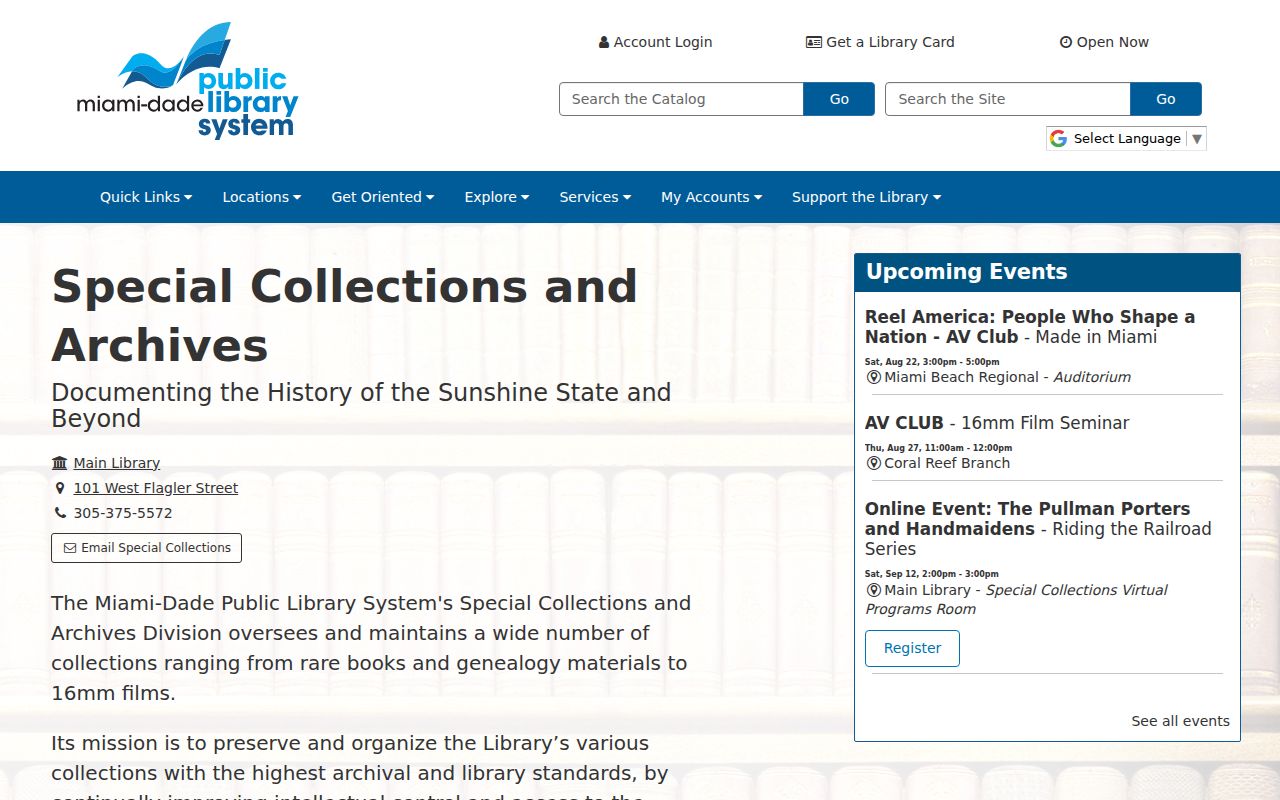
The screen points beyond directories to the Helen Muir Florida Collection, photos, genealogy material, and library-only databases that can explain a name found in print.
HistoryMiami Directory Research
The HistoryMiami Museum Research Center keeps a noncirculating library and archives focused on Miami, South Florida, and the Caribbean. The Charlton W. Tebeau Library includes city directories, yearbooks, newspapers, magazines, ephemera, books, pamphlets, and brochures. Personal papers and organization records sit in the archives. Architectural drawings and about 1.5 million prints and negatives extend an address search into buildings and streets.
Researchers can use finding aids, the catalog, and online publications, then call 305-375-1623 or email archives@historymiami.org. Listed appointment hours are Tuesday through Thursday, noon to 4:30 p.m., and Friday, 10 a.m. to 4:30 p.m. Verify them when booking because an old closure notice remains online.
The Research Center source is shown below.
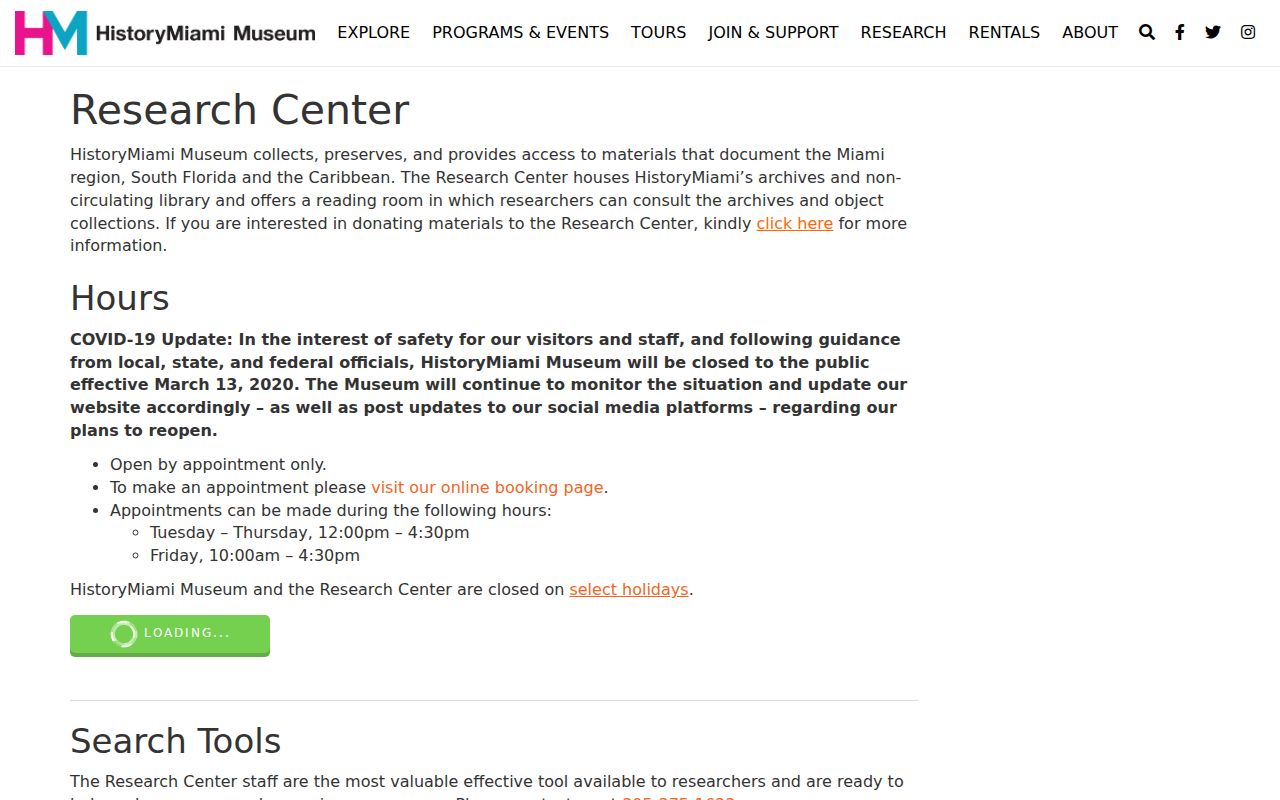
This repository matters when a directory name needs context from a yearbook, business archive, family paper, photograph, or historic building file.
Miami-Dade Directories Between Censuses
Florida gives Miami-Dade research an uncommon time grid. State censuses from 1935 and 1945 fall between federal schedules. The released federal series can be paired with nearby city directories through 1950, while the 1885 state census supplies an early checkpoint. This can narrow a move to a much smaller span than a ten-year census gap.
| Year | Local checkpoint |
|---|---|
| 1885 | Florida state census before Miami incorporation |
| 1896 | Early Dade directory and county history |
| 1935 | Florida state census |
| 1940 | Confirmed Polk's Greater Miami edition |
| 1945 | Florida state census |
| 1950 / 1960 | Released federal census, then confirmed Polk's Miami edition |
A missing person may be indexed under initials, a spouse, a maternal surname, or another spelling. Search compound surnames by each part. Miami-Dade's English, Spanish, and Haitian Creole setting also makes accent and given-name variants worth testing.
Trace Miami-Dade Families by Year
Start near a date you trust, then move one source at a time. Avoid jumping from an early book to modern records and assuming two matching names identify one person.
- Confirm the volume's title, date, publisher, and area. Find the surname and retain the middle initial, spouse, work detail, and exact street wording.
- Check the address or criss-cross section, if present. Note other adults without assuming they are relatives.
- Repeat in the next available city directory in each direction. Track address, spouse, and occupation changes.
- Pair the trail with a Florida state census or the closest released federal census.
- Use deeds, probate, permits, and the obituary index to test why a listing appears or vanishes.
A disappearance can mean death, a move, a spelling shift, a missed year, or a choice not to list. For a modern address inquiry, use the Miami-Dade County street directory workflow.
Miami Arrival Records Add Names
Miami's aviation role gives local genealogy a rare source. MDPLS holds alien-arrival-by-airplane records for Miami from 1930 through 1942. A relative found there can be followed into the nearest city directory, a 1935 or 1945 Florida census, naturalization material, and later newspapers.
Migration research should range beyond one paper and one surname order. Bahamian and Black history in Coconut Grove and Overtown, Jewish life in Miami Beach, Cuban exile after 1959, and Haitian communities around Little Haiti and North Miami appear across community archives, church sources, Spanish-language and Black press, passenger records, and the Cuban Heritage Collection.
New Miami-Dade Surname Files
MDPLS announced remote access to digitized Surname Files on October 3, 2024. Donated family newsletters, trees, and related surname research bridge formal indexes and evidence saved by local families, though each claim still needs an original record.
OCR, the text recognition used on scans, can miss faint type, initials, accents, and damaged paper. Try each part of a compound surname, spelling variants, and a known street or relative. Cite the image and collection details, not only the result list.
Miami-Dade Obituaries Close Gaps
The free MDPLS obituary index has more than 915,000 citations from 1896 through 2008. It is a locator, not the obituary. A hit supplies the newspaper and date for a second search. Miami Herald items may be available through library NewsBank; other titles often lead to Main Library microfilm.
Use the paper that fits the community. Homestead titles may reach southern residents first. The Miami Times can be vital for Black residents, while the Daily Business Review carries many business and court notices. Verify relationships through vital, probate, or cemetery records.