
Finding Miami-Dade County Residents
A useful Miami-Dade County residents directory begins with the kind of fact already known. Put an address in the Property Appraiser search. Check a person's name against the owner roll, the Clerk's recorded-document index, court dockets, Sunbiz filings, and license records. An older address belongs in printed directories, deeds, census schedules, and newspaper indexes. Each source answers a narrow question. The tax roll identifies assessed owners, not all occupants, while a voter extract covers only registered voters whose information is not protected.
Write down names, spelling variants, dates, folios, and legal descriptions exactly as shown. Compound surnames, maternal surnames, accents, and initials may be indexed in several forms. Search each form, then compare independent records. A match is stronger when the same middle name, address, co-owner, date, and parcel description recur.
- Search the county property roll by owner or address, then save the folio and legal description.
- Use Florida voter tools or request a lawful public voter extract when registration evidence fits the question.
- Search the County Recorder by party name, CFN, book and page, or legal description.
- For earlier households, consult library directories, censuses, and newspaper indexes.
- When the online trail ends, contact the keeper or make a focused Chapter 119 request.
Miami-Dade Resident Records Offices
The Clerk of the Court and Comptroller is both court clerk and County Recorder. Its records hub connects deeds, liens, plats, marriage licenses, probate, civil and criminal cases, tax deeds, and code files. The Property Appraiser keeps the assessment roll. Elections handles voter records. Regulatory and Economic Resources keeps many county permit and enforcement files. Municipalities may hold their own permits, code cases, local tax, and police records, so jurisdiction must be checked before a request is sent.
County Recorder
20 NW 1st Avenue, Suite 5.246
Miami, FL 33128
305-275-1155
Official Records
Property Appraiser
Countywide assessment roll
Miami-Dade County, FL
305-375-4712
Property Search
Miami Address or Municipality
A postal line that says Miami does not prove that a parcel sits inside the City of Miami. Miami-Dade County contains 34 municipalities and a large unincorporated area. Countywide deeds, assessments, elections, and courts may apply, while permits, local business taxes, police incidents, and code files can belong to a city. The county's MARS address validator accepts a full or parsed address plus optional ZIP and municipality. Use its result and the parcel folio to identify the right keeper.
This check prevents a common dead end. A county building search may return nothing because Coral Gables, Hialeah, Miami Beach, Homestead, or another city holds the file. Historical work also needs the jurisdiction in effect at that time. Government borders changed while postal labels did not always follow them.
Miami-Dade Property Search Fields
The Miami-Dade Property Search is the best official starting point for an address or owner. It is free and needs no account. The roll is continually edited and serves tax assessment, so verify title through deeds. A parcel card separates the property, or situs, address from the owner's mailing address and supplies the folio and legal description.
| Search choice | Input | Useful result |
|---|---|---|
| Address | Street and optional suite | Parcel and map |
| Owner Name | Person or entity | Owned parcels |
| Subdivision | Recorded name | Platted lots |
| Folio | 13-digit parcel ID | Exact parcel card |
Cards may show owner, mailing and situs addresses, values, exemptions, sales, land and building traits, aerials, and a sketch. These details distinguish similar names. They do not list all residents. Homestead and matching mailing and situs addresses support owner occupancy but never prove the whole household.
Current Miami-Dade Resident Directories
No government master list names everyone in Miami-Dade County. The residents directory is strongest when several limited official rolls are treated as separate evidence. Access differs by keeper, and protected records stay unavailable.
| Source | Who It Lists | Keeper | Access |
|---|---|---|---|
| Assessment roll | Owners | Property Appraiser | Free portal |
| Voter extract | Nonexempt registered voters | Elections | Records request |
| Official Records | Recorded-document parties | County Recorder | Free standard index |
| Court indexes | Parties in accessible cases | Clerk | Standard or registered |
| Association registry | Community associations | County RER | Free, not a member roll |
A name in one roll proves only a role in that record. Business officers may use a work address. A court party may have moved. An owner may live elsewhere. The Miami-Dade resident lookup shows how to compare names, dates, co-parties, and addresses.
Miami-Dade Deeds Beyond 1974
The County Recorder's index covers most recorded documents from 1974 forward. That date marks web coverage, not the start of deeds. Search deeds, mortgages, liens, plats, judgments, domicile declarations, releases, and powers of attorney by party, CFN, book and page, or legal description.
The Clerk's Official Records page appears in this source capture.
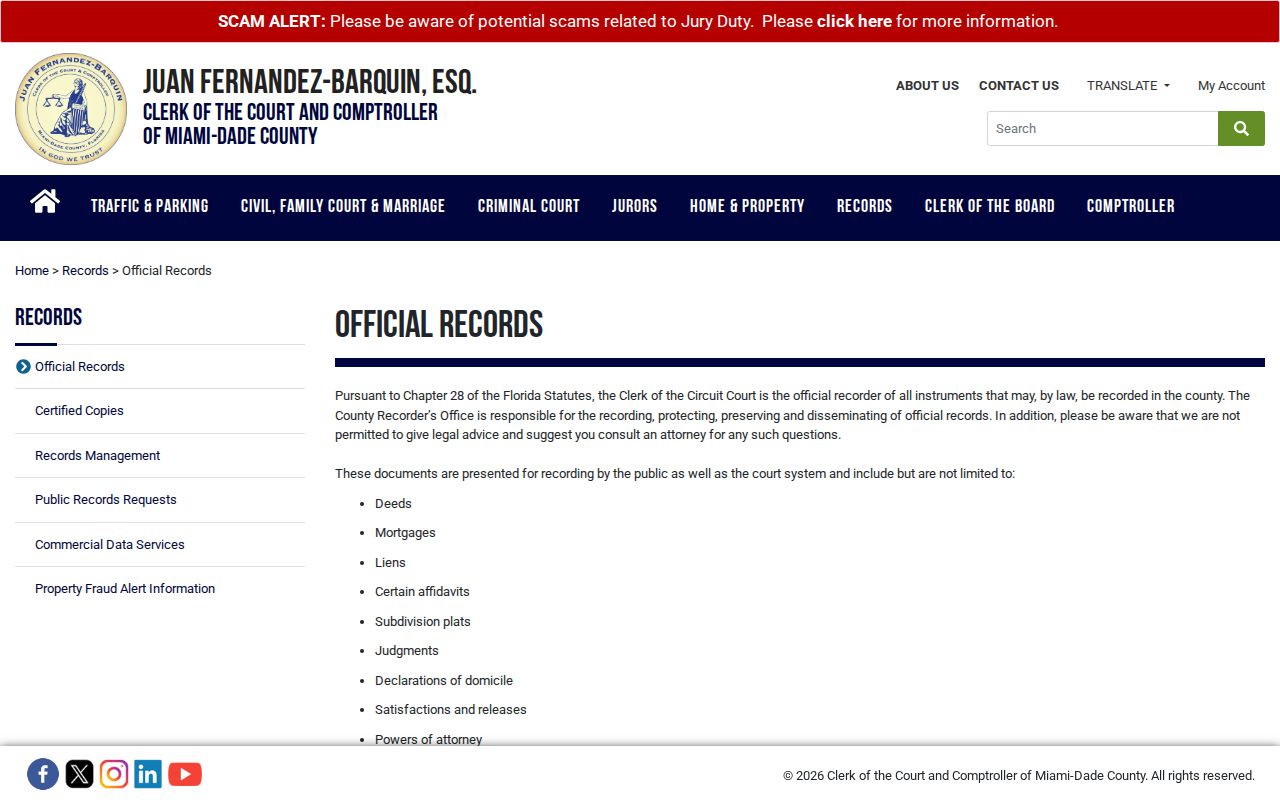
When the online chain stops, the Records Library keeps all recorded-document copies and indexes. Public computers and staff help are available. Staff research is $2 per name per year. Copies cost $1 per page and certification adds $2. Mail requests need the full name and document type, plus an address or legal description for deeds and mortgages.
Note: Carry a deed seller backward as an earlier grantee, matching the same legal description at each link.
Miami-Dade Court Name Indexes
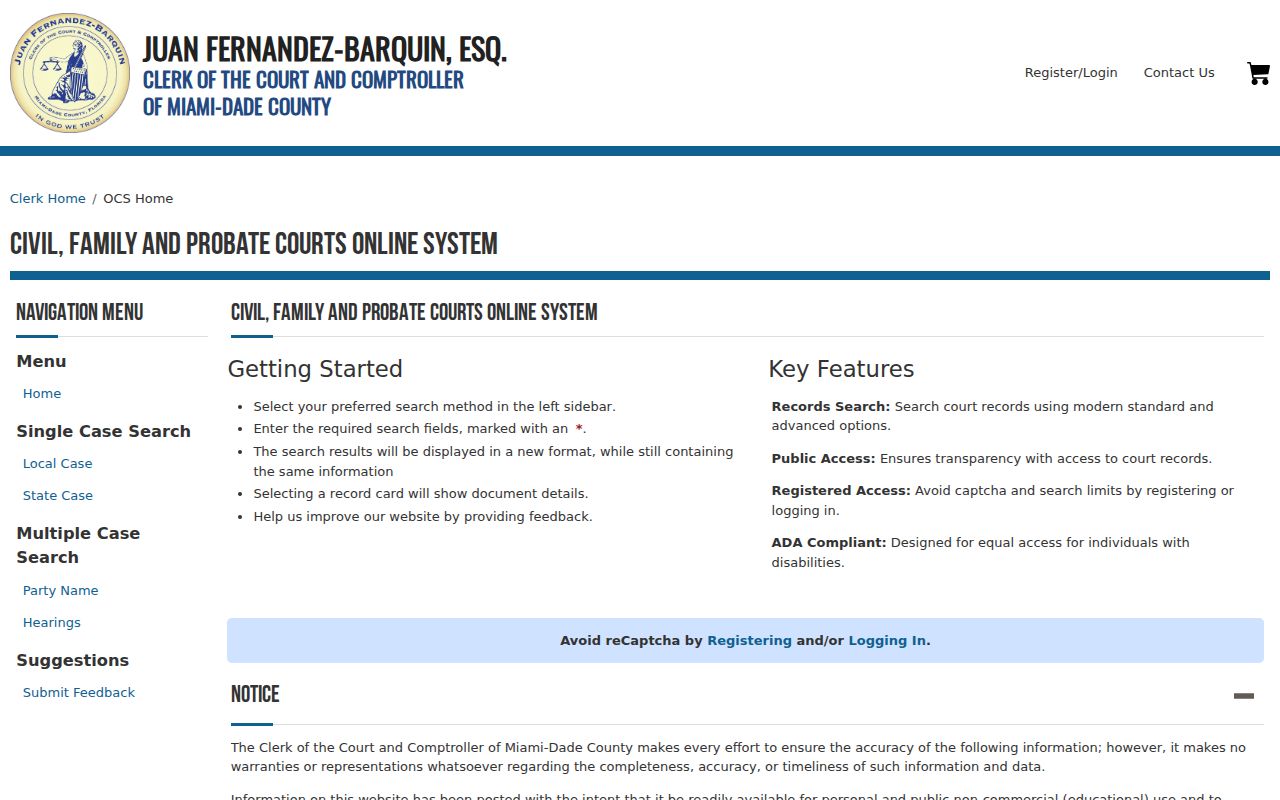
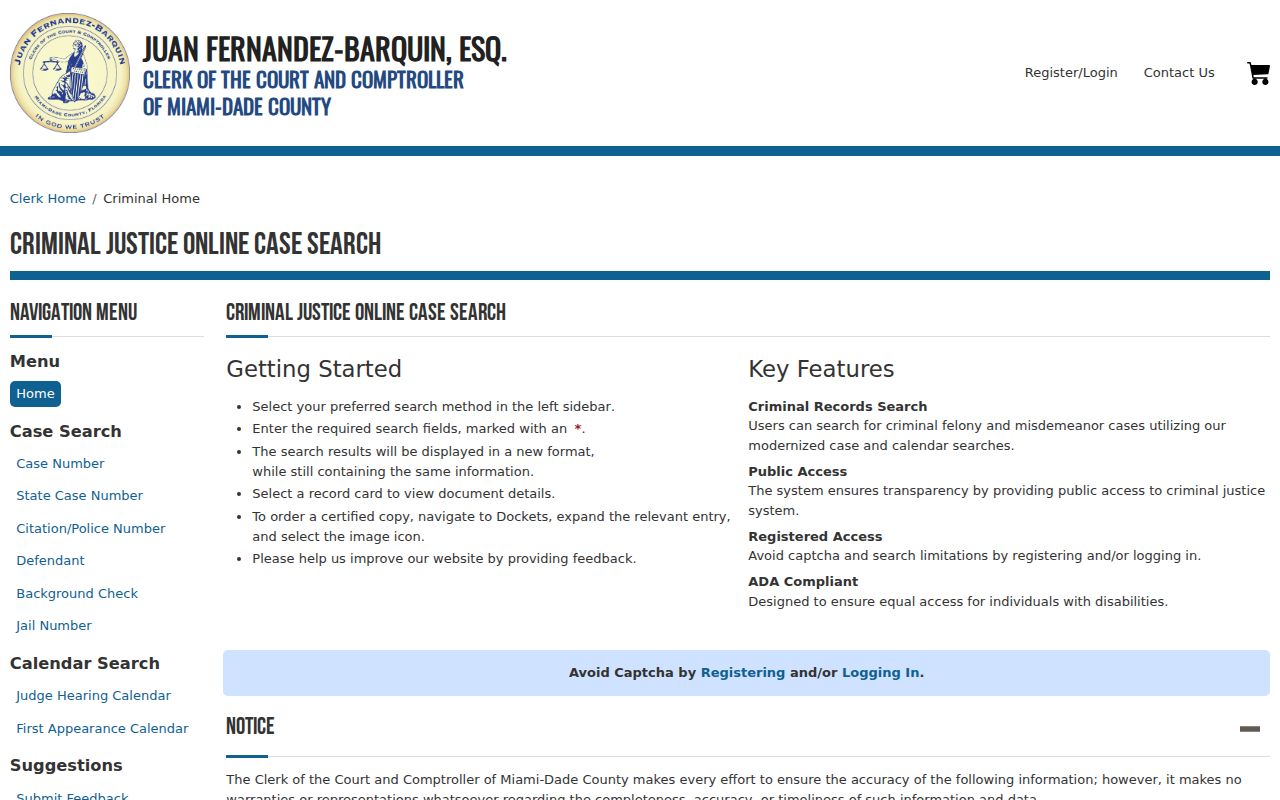
The Clerk has separate systems for civil, family, and probate cases and criminal cases and calendars. Registration expands only the access Florida's court matrix permits. Sealed, juvenile, and other protected files remain closed. Florida has no unrestricted public statewide trial-court name portal.
Read party role, case type, filing date, docket, and disposition before using a hit. A docket is the ordered list of case events. A name match does not resolve two people with the same name, and a charge does not prove conviction. Probate files may identify estate representatives, heirs, property, and addresses when those filings are public.
The civil and probate search appears in this captured view.
The separate criminal case and calendar screen appears next.
Florida Voter Data Limits
The Florida Voter Information Lookup helps a voter check personal status and precinct details. Broader public extracts follow sections 98.095 and 97.0585, Florida Statutes. They can support name, residence, precinct, ZIP, status, and registration-history research, but are not a full resident roll.
Social Security numbers, driver-license or state-ID numbers, signatures, and protected addresses are excluded. Safe at Home participants and some high-risk people have shielding. Minors, noncitizens, nonregistrants, and recently changed records may also be absent.
Lawful use. Never use an address or identity trail to stalk, harass, threaten, or harm anyone.
Free and Paid Miami-Dade Records
Most Miami-Dade lookup indexes are free. Payment usually buys a copy, certification, staff time, or special research product. Recorded copies cost $1 per page and certification adds $2. County open-permit research costs $43.75, while an enforcement-lien search costs $250. A free portal can answer many questions when the address and jurisdiction are right.
| Route | Best use | Limit |
|---|---|---|
| Official index | Find a candidate | May omit images or older records |
| Staff search | Defined name or parcel | Fees apply |
| Certified copy | Authenticated office copy | Separate from the index |
| Commercial category | Possible lead | May be stale or merged |
Official records are preferable because each has a named keeper, purpose, and correction route. A commercial profile should never replace direct verification.
Miami-Dade Public Records Requests
Florida's Public Records Law, article I, section 24 of the state Constitution and chapter 119, lets any person inspect or copy nonexempt records. A requester need not live in Florida, state a purpose, identify themselves, use a form, or write the request. Custodians respond in good faith within the reasonable time needed for retrieval and review.
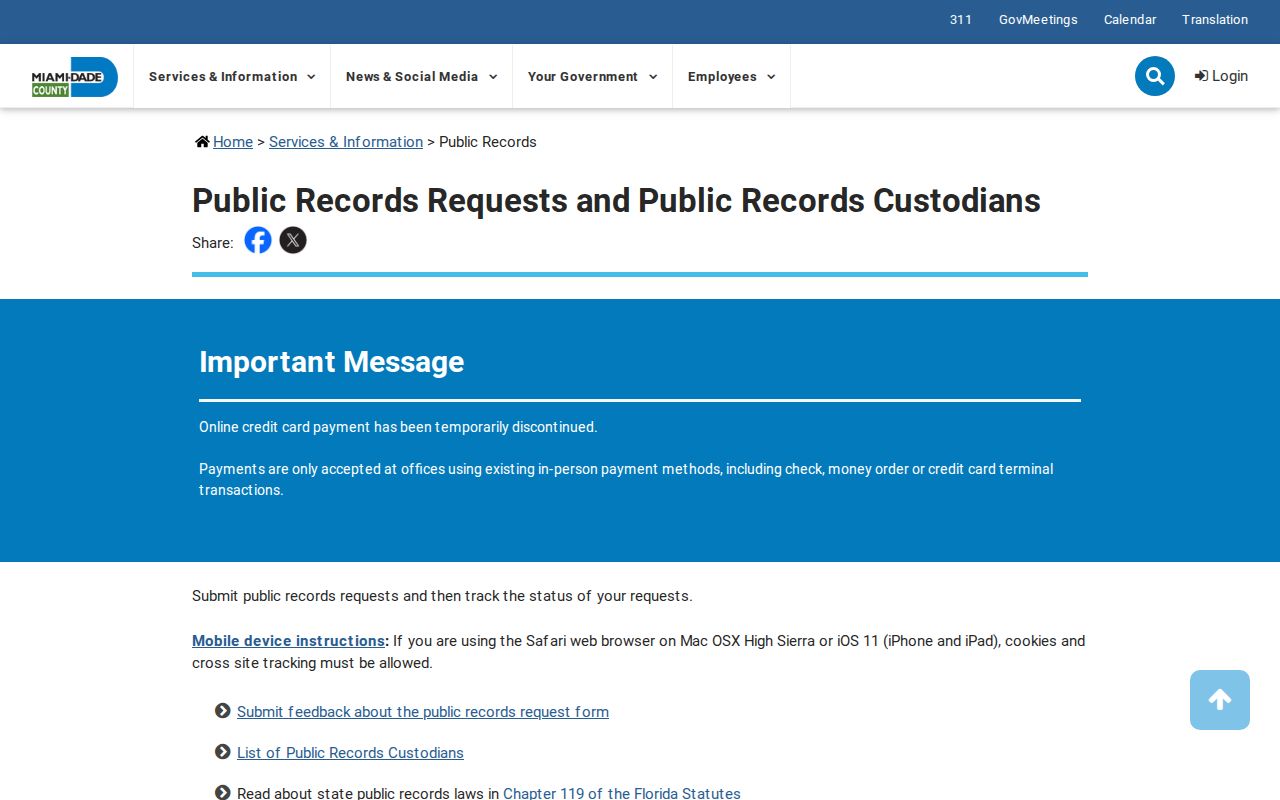
The county's GovQA portal submits and tracks requests, while oral and anonymous requests remain valid. Name the department, record type, date range, spelling variants, address or folio, and file format. Miami-Dade may assess copy fees and special service charges for extensive work.
The official request interface is shown below.
Miami-Dade Business Identity Records
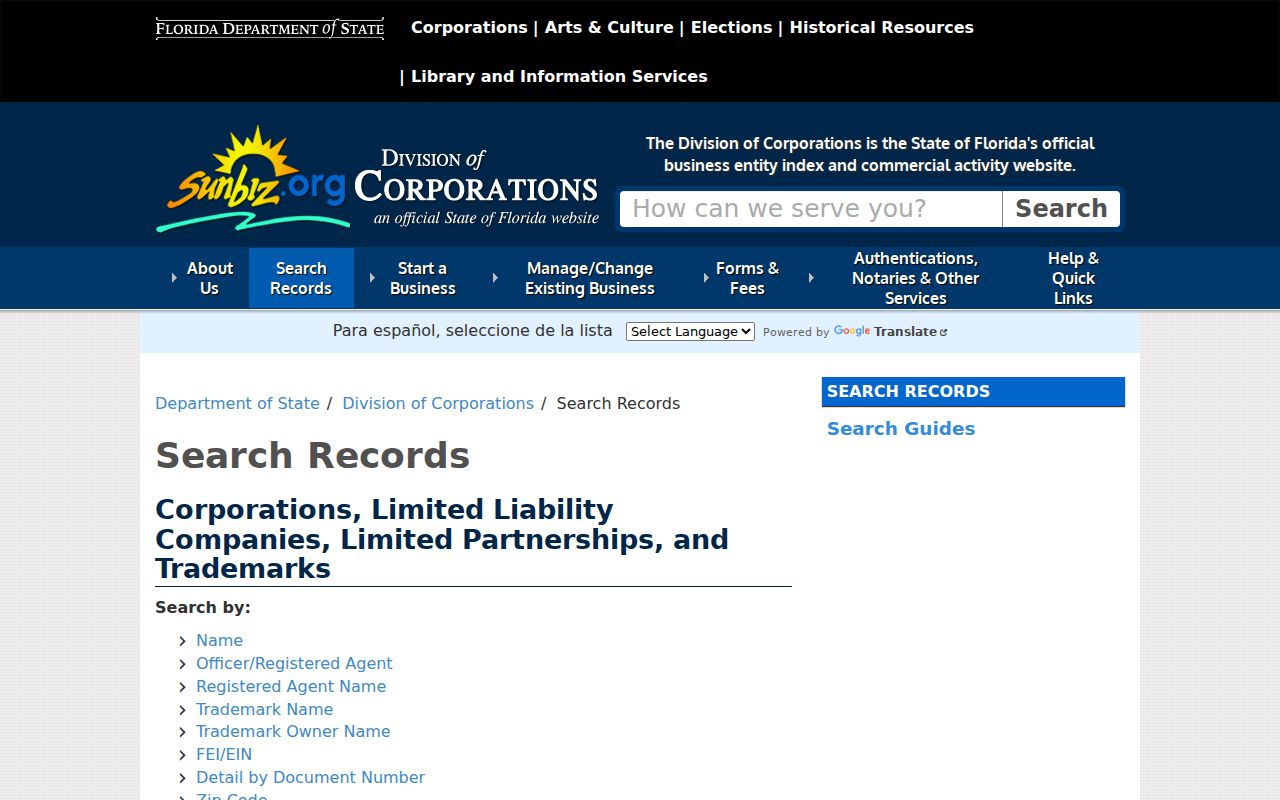
Florida's Sunbiz search hub connects names with corporations, limited liability companies, partnerships, fictitious names, agents, and filed liens. Filings may show officers, managers, mailing addresses, document dates, and images. These are business roles, not proof of a home address.
The official search choices appear below.
Professional identity can also be checked through DBPR or Health practitioner profiles. Record the license number and status, but do not infer residence from an office address.
Miami-Dade Directory Terms
Several terms help readers move between the Miami-Dade County residents directory and its source records.
- Roll
- An official working list, such as an assessment roll or voter extract.
- Index
- A finding aid that points to a record but may omit the image.
- Parcel and folio
- A parcel is mapped land; the folio is Miami-Dade's identifier.
- Criss-cross directory
- A printed directory arranged by address rather than surname.
Keep CFN, book and page, folio, case number, title, and date with every note. Those keys make a search reproducible and reduce same-name errors.
Historical Miami-Dade Resident Directories
Older residents require sources beyond current portals. Miami-Dade Public Library System's genealogy holdings exceed 27,000 bound books and 35,000 microforms. The rare 1896 Directory, Guide & History of Dade County names residents and businesses but covers land now in Broward and Palm Beach counties. Later editions may show occupation, spouse, and street address. Address-first criss-cross volumes help when only the dwelling is known.
Florida's 1935 and 1945 state censuses fill gaps between federal schedules. The library obituary index contains more than 915,000 citations from 1896 through 2008, each pointing to a newspaper and date. The detailed shelf method belongs in the Miami-Dade city directory collections. HistoryMiami, the State Library, and university archives are useful when an item is not online.
Miami adopted a street renaming and numbering system in 1920. When a person seems to vanish, compare folios, plats, abbreviations, and period maps before deciding that the household moved.
Access is split between online and reading-room channels. Miami-Dade Public Library System Special Collections offers genealogy and local-history material, while HistoryMiami preserves maps, photographs, manuscripts, architectural records, and scarce printed works. The State Library also holds Florida city directories, though its exact Miami run should be confirmed before a trip. University of Miami and Florida International University special collections add community and institutional records. These repositories are not current household lists. They preserve evidence that official portals were never designed to keep.
New material continues to appear. The library made donated Surname Files available remotely in October 2024 and still invites residents to contribute pre-2000 photographs, letters, scrapbooks, print, and audiovisual items through its Community Memory Project. Donors keep their originals and receive a high-resolution copy. Such collections can document relationships, clubs, streets, and community events missing from deeds or tax rolls, subject to donor and privacy limits. Pair any archival name with a date, source title, and location before connecting it to a modern resident.